- Robert meets World
- Posts
- The Engineer's Dilemma: Factorio is Solvable, Startups... Maybe Not
The Engineer's Dilemma: Factorio is Solvable, Startups... Maybe Not
How the engineering mind struggles to debug a probabilistic world and what we can learn about it using the game Factorio.

Robert Simoes
December 09, 2025
For tl;dr go to [3]
So I fell down the rabbit hole of the game Factorio, the logistics and efficiency simulator.
For the uninitiated, the game is exactly what it sounds like: you build factories to automate the production of increasingly complex resources.
I found it hilarious.
After 30 minutes of total flow I realized the analytical preference my brain has.
I was more engaged optimizing virtual conveyor belts than I have been previously playing DotA 2.
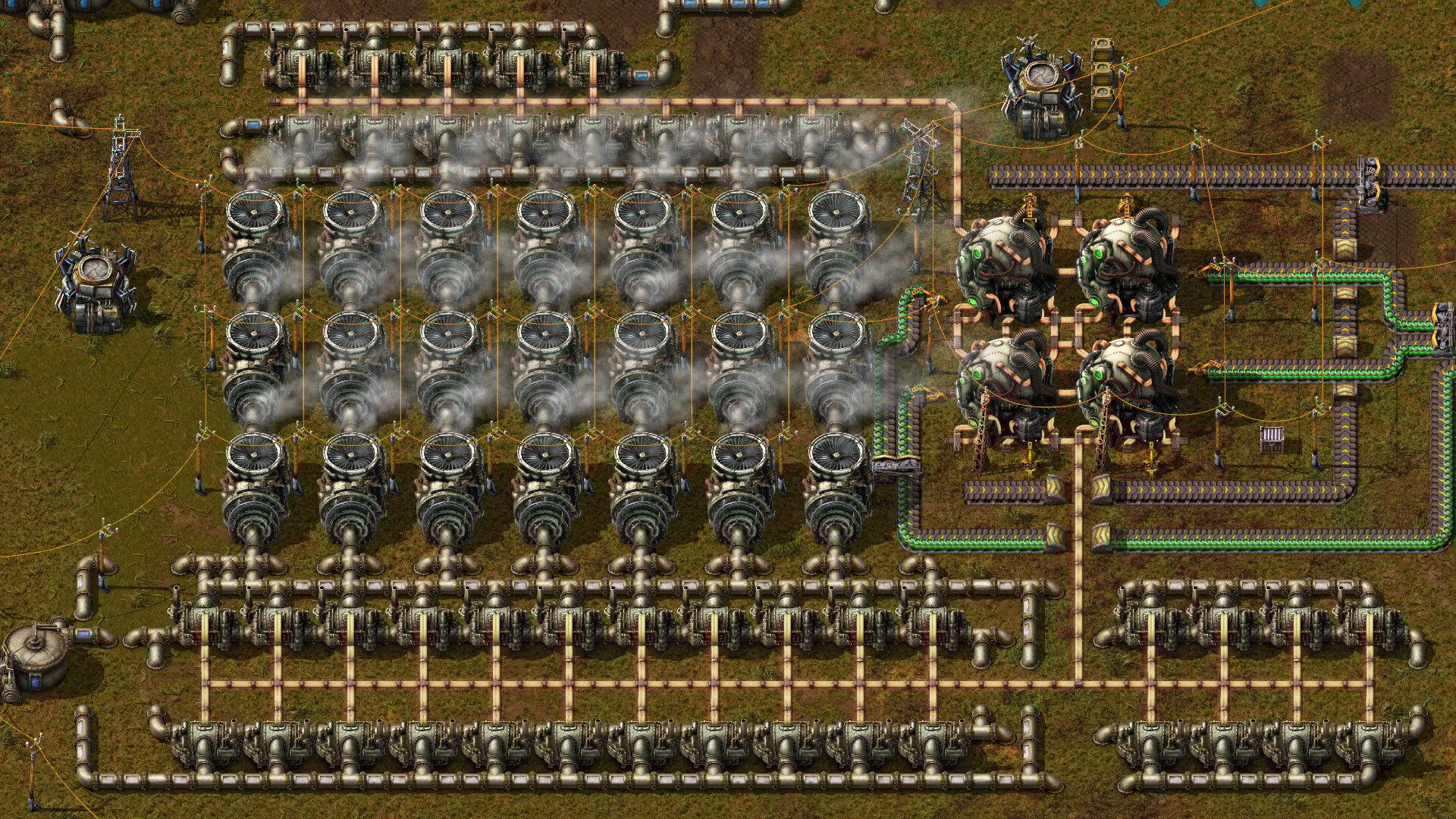
Factorio factory
However, as I watched my virtual factory hum along, I realized my engagement wasn't just about "efficiency", but rather, safety.
Factorio can become a enthralling because it is deterministic.
It’s like a sanctuary for the engineering brain.
A flow fueled adventure of dependency chains (“this is connected to this and this”) and the Zeigarnik Effect (“just one more fix…” loops)
You know that every time you use a plus operator, there is something solid underneath that outputs the correct sum.
If you feed one iron ore into a furnace, you will get one iron plate: every time (if you remember to keep the furnace blazing with fuel that is).
The real world, and specifically the world of entrepreneurship, is not Factorio (the resounding sound of “duh!” ringing in my head).
It is not deterministic; It is a hostile, probabilistic mess.
The frustration many technical founders feel isn't a lack of skill; it is a "System Error" caused by trying to run deterministic software on probabilistic environment.
The Root of Imposter Syndrome: A Category Error
We can actually trace a specific strain of Imposter Syndrome back to a craving for Factorio-style determinism.
When you start a business, you feel a dissonance.
You know you are capable based on past experience, but you are effectively new to this specific environment.
You are looking for a logical deduction (If I do X, Y will happen), but what you don’t know is that the feedback loop is broken (or at least an frustrating Rube Goldberg machine).
In engineering, if the system fails, you check syntax, whether npm is running or if you forgot to start the docker container.
In entrepreneurship, if the "code" (your product) fails, it might be the syntax, or it might be that the market (the compiler) was in a bad mood that day.
That lack of a guaranteed output makes you feel stupid.
But you aren't; you are just suffering from a category error [4]
You are searching for a deterministic result in a probabilistic situation.
The "Hostile Function" of Building
This is the difficult math of starting a business compared to playing a game, and the major metaphor I used to communicate my frustrations while creating learningtodj.com.
In Factorio, you have a reliable function:
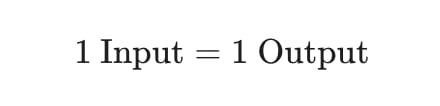
In a business, you begin with a "Hostile Function." You aren't just battling for efficiency; you are battling for existence. The equation looks like this:

The engineering mind hates this.
It wants to optimize immediately (and this got me into trouble, more to be told later).
It wants to build a faster conveyor belts.
But in the early days, you cannot optimize, because you don't even know if the machine works yet.
There is no tutorial prompt telling you to "build a copper wire assembler next."
You have to discover what you don't know.
The pain you feel is the wasted energy of feeding inputs into a black box that gives you zero feedback.
It is not a failure of will, but rather, failure of information.
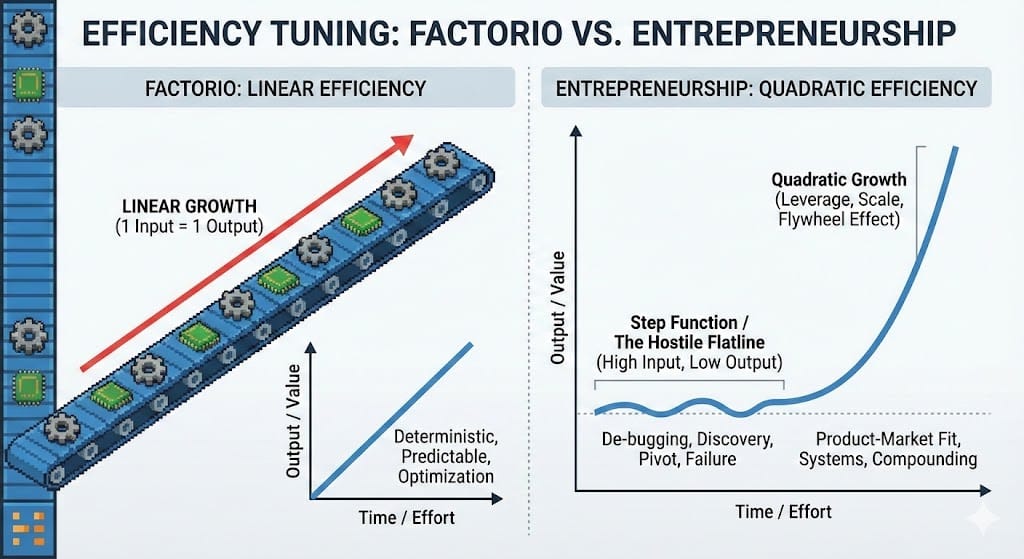
Gemini generated: For the efficiency minded, this is just for illustrative purposes! Please don’t burn me at the stake for criticizing your Factorio factories quadratic production.
Technical Truths vs. The "RNG" of Social Truths
In Factorio, the constraints are "hard technical truths" (i.e., physics, math, logic) programmed into the safe container.
There is no "luck" stat.
The “game” of entrepreneurship interfaces with the social world.
As Balaji Srinivasan points out, the social world follows "social truths."
Social truths are not based on facts, but on consensus.
From the gaming lens, the social world has an implicit RNG (Random Number Generator).
Technical Truth: Because solid mathematical proof X, we know that when we compile this code it will produce Y result everytime
Social Truth: Today, company X has the main narrative capture, so the market decides it prefers that to the competitor's product Y (i.e., you need to sell+market not just build)
When you build something like a product, you aren't debugging; you are debugging human psychology, market timing, and shifting consensus.
Unfortunately, you are building on ground that moves (could you pick a more frustrating situation?).
To the rational mind, this feels unfair, because it is randomness interfering with logic.
The Finite Resource: Entropy
Moreover, there is one final difference between the simulation and reality that creates anxiety.
In Factorio, you technically have infinite time.
You can spend 7,000 hours tweaking a layout, and the only cost is your sleep schedule. If you stop playing, the factory waits (and the factory must grow).
In entrepreneurship, you are battling entropy.
You are balancing two finite resources: Time and Money.
The "game" of business has a built-in decay rate.
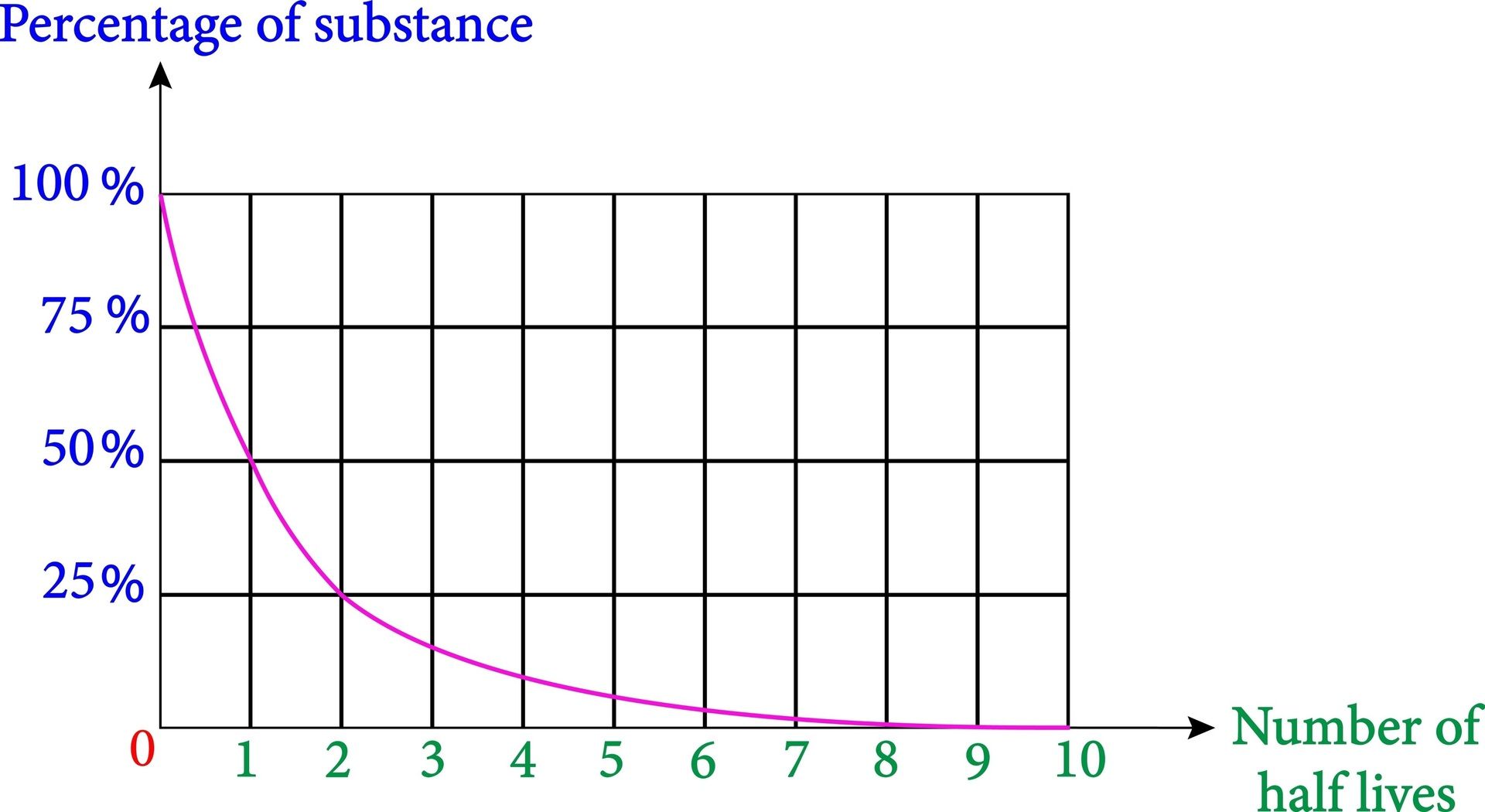
Decay rate example
If you do nothing, your seed cash burns and the market window might close. [2]
In the simulation, you can pause to think.
In reality, the entropy counter is ticking down.
The Takeaway: It’s Not About "Grinding"
The conclusion usually drawn from this comparison is that you need to "grind harder" to overcome the Hostile Function.
I disagree. It can help, but I think it can lead to burnout.
My real intention with this post is demonstrating empathy for you and me!
If you are a logical thinker, building + distributing something feels agonizing because it violates the rules of causality relied on.
You are trying to build a machine that turns raw resources into value, but the machine is full of glitches, the users are unsure, and the physics engine can change every year.
So you have to accept the glitch, maybe begrudgingly.
You have to accept that for a long time, the factory will be horribly inefficient.
It does not give the dopamine release of a guaranteed "plus one." [1]
So don’t beat yourself up for craving the safety of the conveyor belt.
Understand that you have moved from a game of optimization (Factorio) to a game of discovery (Entrepreneurship).
Your goal isn't to run the factory perfectly; it's just to figure out the blueprints before the lights go out.
And if not… it’s just another game in the Finite and Infinite Games of life!
Footnotes
[1] This is also what you are battling against culturally now that social media products have been tuned for psychological exploitation.
[2] Entropy creates a “floor is lava” tension, which is threaded in many aspects of daily life creating persistent anxiety. One being the artificial game of target inflation and interest rate manipulation to grow / contain markets.
[3] Here is Google Gemini’s tl;dr
The Thesis:
Technical people love games like Factorio because they are deterministic (safe, logical, solvable). Real-world entrepreneurship is probabilistic (hostile, random, chaotic). The anxiety founders feel isn't a lack of skill—it's the friction of trying to apply deterministic logic to a probabilistic game.
Key Points:
The Craving for Safety: We get addicted to Factorio because 1 input = 1 output. It heals the "Imposter Syndrome" caused by the real world's unpredictability.
The Hostile Function: In a business, the math is broken. You put in 100 inputs (effort) and often get 0 outputs (results) initially. This "bug" drives engineers crazy.
Social RNG: In code, errors are logical. In business, errors are often "Social Truths" (consensus/trends) acting as a Random Number Generator that messes up your plans.
The Shift: To succeed, you must stop trying to "optimize" the factory immediately (as if it were a game) and accept that you are in a phase of Discovery. You aren't building a conveyor belt; you're betting against entropy.
[4] A Category Error (or category mistake) is a semantic or ontological error in which things belonging to one particular category are presented as if they belong to a different category, or when a property is ascribed to a thing that could not possibly have that property.